Human-centred AI
Responsible AI that works for people and delivers lasting value
People shape AI
AI's impact on people and society isn't a by-product of the technology. It's the result of countless decisions - about what gets built, for whom, and how it's deployed.
Having worked for over 20 years in human-centred design, I believe the people who study how humans actually think, behave and make decisions have a real place in shaping AI - ensuring it works for us.
MA in Artificial Intelligence
Deepening my AI expertise through postgraduate study at the University of Southampton
I'm pursuing an MA in Artificial Intelligence (Digital Transformation) at the University of Southampton - a two-year, part-time, fully online programme that fits around my work commitments.
The programme sits within the School of Economics, Social and Political Science and has been developed in collaboration with the School of Mathematical Sciences and the Web Science Institute - a renowned interdisciplinary research centre directed by Professor Dame Wendy Hall, with Professor Sir Tim Berners-Lee as a visiting professor.
I chose the Digital Transformation pathway because it focuses on where my interest lies: how AI is reshaping the workplace, society and the wider economy - and how to lead that change responsibly.
What I'm studying
- Introduction to AI, and how AI works
- Working with AI applications and generative AI
- Responsible AI - ethics and societal impact
- AI in social problem analysis and policy formation
- AI transforming the workplace
- AI, governance and the global economy
The programme culminates in a research design module and an independent dissertation.
Why this programme
Unlike more technical, computer science-focused AI programmes, this MA is designed for professionals moving into leadership in AI-driven environments. It combines rigorous academic foundations with practical application - equipping graduates to lead AI adoption and digital transformation, and make informed technology decisions.
This focus aligns closely with my goal of leading AI projects and transformation - bringing human-centred design to how organisations adopt AI, so it delivers real impact and is applied responsibly.
Questions I'm exploring
- Can AI be designed to leave us more capable rather than less? AI systems learn from what we rate highly, and in the moment we tend to prefer the answer that does the thinking for us. So how can we design AI to elevate our capabilities, rather than erode them?
- What gets measured gets improved. We measure what AI can do, but how can we measure what AI does to us - to our wellbeing, our judgement and our relationships?
- “Have a human check it” is a commonly used safety net for AI systems. But human oversight gets worse when we're tired, rushed or over-familiar, which is exactly when we lean on AI most. What design interventions can strengthen human oversight?
- If we spend hours a day talking to AI, does it change how we talk to each other? If an AI is flattering or, conversely, more transactional, do we pick that up? And do we start finding real people disappointing next to something endlessly positive and patient?
- Could AI chatbots divide us more deeply than social media has? Social media shows us what we already agree with. A chatbot goes further: it agrees with us, then hands us a sharper, more persuasive version of our own argument.
- How do we move on from “will AI take our jobs?” to better questions: what we choose to use it for, how we decide, and who decides? And should we have the right to opt out?
- If workplaces now expect us to use AI, do they owe us more than productivity training? We have guidelines for display screen equipment and online security - should there be an equivalent for the risk of leaning too heavily on these tools, and the potential harms that follow: decision surrender, skills atrophy, artificial attachment?
Articles
Longer-form writing on design, AI and where the two meet
AI certifications
Building practical expertise to lead teams through AI adoption in design practice
AI fluency: framework & foundations
An understanding of how to collaborate with AI systems effectively, efficiently, ethically and safely.
Teaching AI fluency
This course empowers academics, instructional designers and others to teach and assess AI Fluency.
Why this matters for design leadership
As a design leader, understanding AI isn't just about personal productivity - it's about guiding teams through technological change, helping designers understand how AI can augment their work and ensuring we maintain human-centred principles as AI becomes more integrated into our practice.
AI-assisted projects
Hands-on exploration of AI tools in product design and development
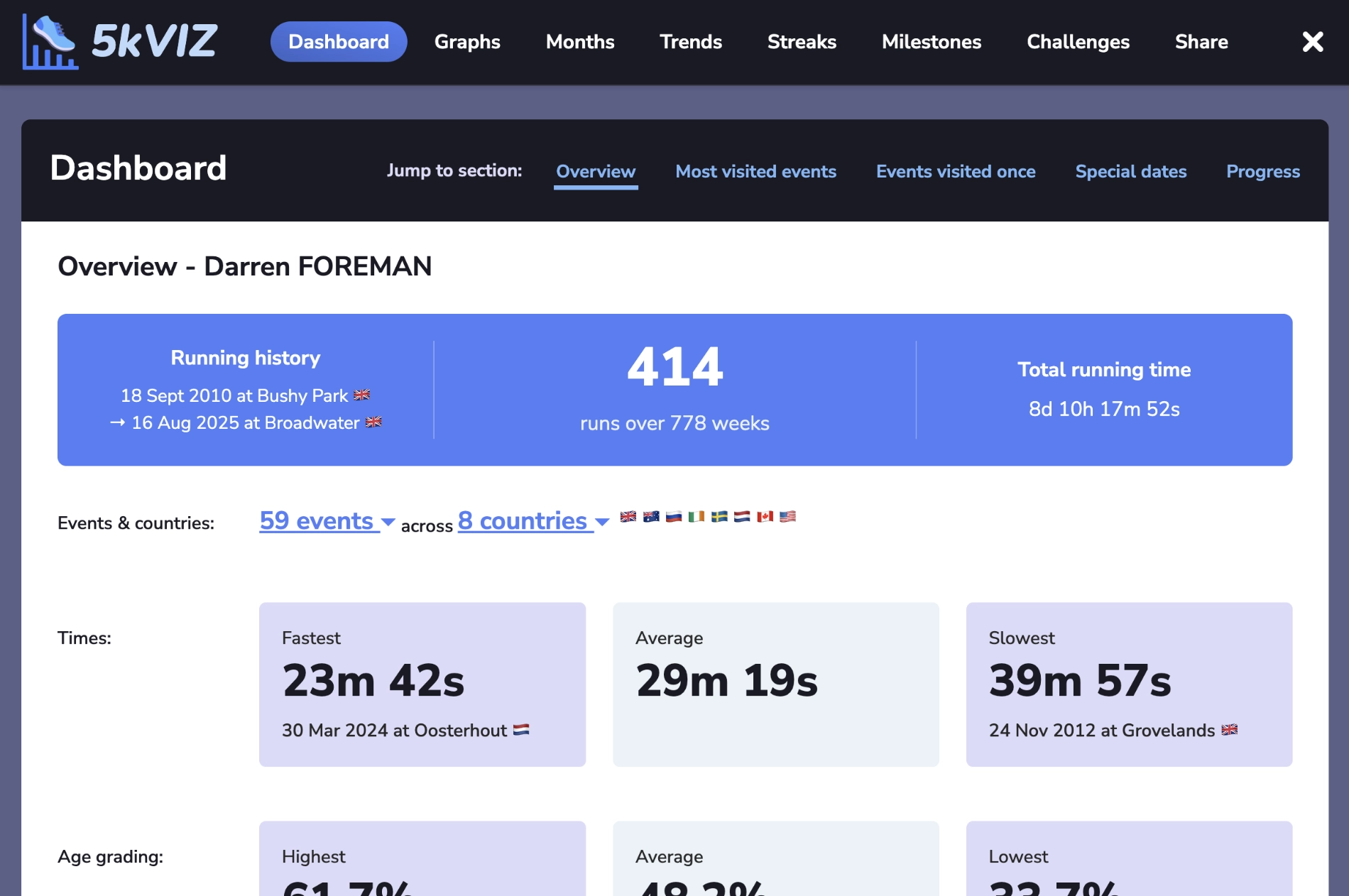
5kVIZ: browser extension for parkrun data
A practical exploration of AI-assisted product development from strategy through to launch
The challenge
Parkrunners wanted better ways to visualise their performance data and gain deeper insights beyond the basic statistics provided by the official website.
The approach
Developed collaboratively with an engineering partner, using AI tools throughout the entire process:
- Market Research: Used AI to analyse user needs, the competitive landscape and feature opportunities
- Business Planning: Developed strategy, positioning and roadmap with AI assistance
- Design: Explored brand and UI design directions and created social media content
- Front-End Development: Built the extension with AI-assisted coding leveraging my existing front-end skills
The outcome
Successfully launched a browser extension that enables parkrunners to visualise their performance data in new ways. The project served as a valuable hands-on exploration of how AI can accelerate product development while requiring human judgement for strategic decisions, design quality and user experience.
Key learning
AI tools dramatically accelerate development but require clear human direction, critical thinking and quality judgement. The designer/developer's role shifts from execution to orchestration - but becomes no less important.
AI tools used
For leadership
This hands-on experience gives me credibility when guiding teams through AI adoption. I understand both the opportunities and the challenges firsthand.